A Modern
Pedagogical
Framework
Helping educators create engaging, research-backed, student-centered learning experiences — bridging NEP 2020 vision with real classroom practice.
What is the INSPIRE Framework?
The INSPIRE Pedagogical Framework is an innovative, holistic teaching-learning model designed to align classroom practice with the transformative vision of India's National Education Policy 2020.
It integrates seven carefully designed phases — each representing a distinct yet interconnected dimension of learner-centered education. From stimulating curiosity to fostering student agency, INSPIRE creates learning environments that nurture the whole child: intellectually, emotionally, and socially.
Explore the 7 Phases“Education is not the filling of a pail, but the lighting of a fire.”
— W. B. Yeats
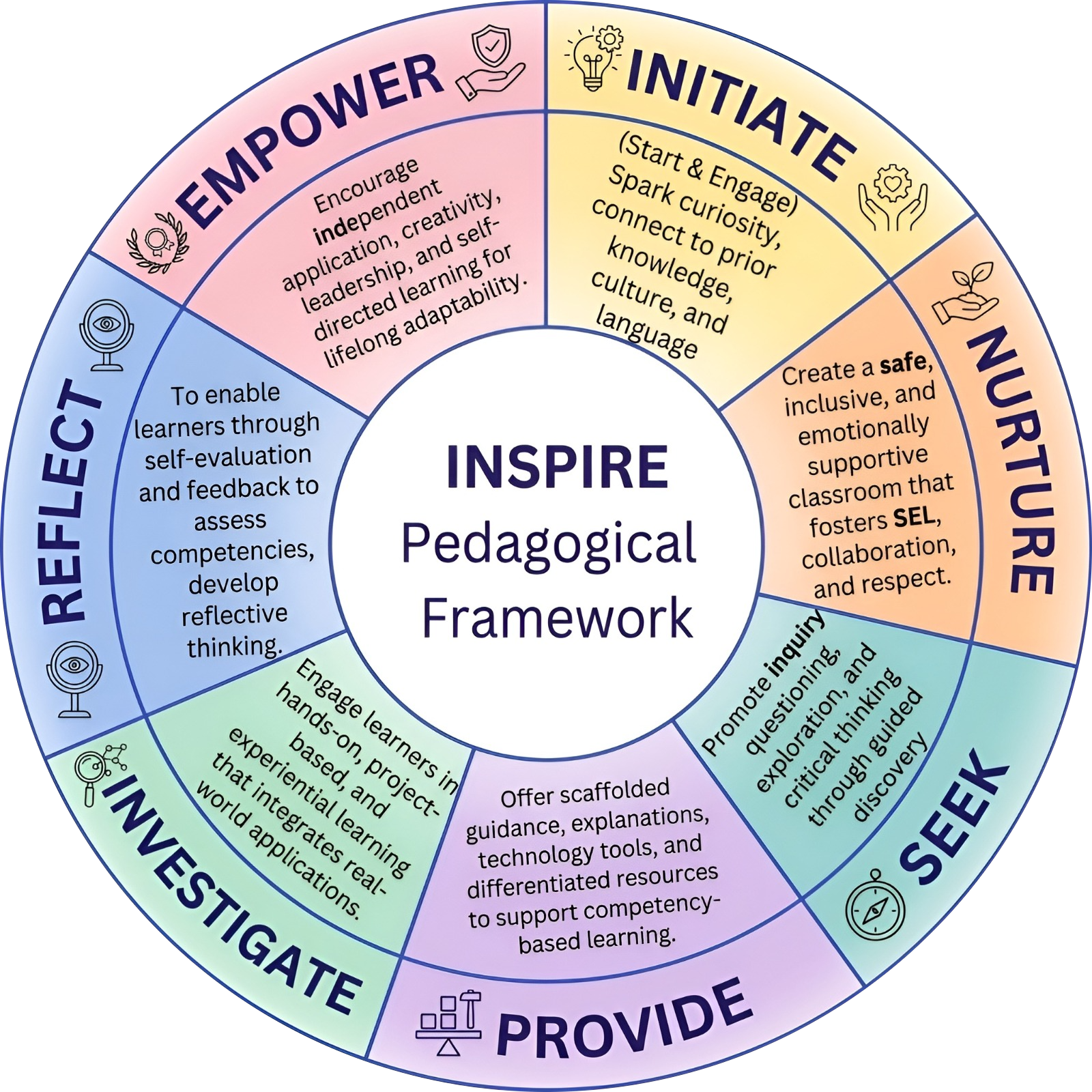
7-Phase Cyclical Model
Initiate → Nurture → Seek → Provide → Investigate → Reflect → Empower
The 7 Phases of INSPIRE
Each phase is a deliberate pedagogical step guiding teacher and learner through a transformative educational journey aligned with NEP 2020 outcomes.
Start & Engage
Initiate
Spark curiosity, connect to prior knowledge, culture, and language to prepare learners for new concepts.
Sustain & Support
Nurture
Create a safe, inclusive, emotionally supportive classroom that fosters SEL, collaboration, and respect.
Question & Discover
Seek
Promote inquiry, questioning, exploration, and critical thinking through guided discovery.
Scaffold & Deliver
Provide
Offer scaffolded guidance, explanations, technology tools, and differentiated resources to support competency-based learning.
Explore & Apply
Investigate
Engage learners in hands-on, project-based, and experiential learning that integrates real-world applications.
Evaluate & Grow
Reflect
Enable learners through self-evaluation and feedback to assess competencies and develop reflective thinking.
Lead & Transform
Empower
Encourage independent application, creativity, and self-leadership for lifelong adaptability.
The seven phases form an interconnected, cyclical progression — each building upon the previous to create a holistic experience for every learner.
Why INSPIRE is Needed
Traditional education systems face systemic challenges that hinder holistic learner development. INSPIRE addresses each gap with evidence-based pedagogical solutions.
Traditional Education
Challenges that limit learner potential
- Rote memorization & passive recall
- Exam-oriented, marks-driven instruction
- Passive, teacher-dominated classroom
- One-size-fits-all pedagogy
- Isolated, siloed subject learning
- Emotional dimension ignored
INSPIRE Approach
21st-century education solutions
- Critical thinking & creative problem-solving
- Competency-based, holistic education
- Active inquiry & learner agency
- Differentiated, inclusive teaching
- Interdisciplinary integration
- Social-emotional growth prioritized
Aligned with Global & National Policies
Theoretical Foundations
INSPIRE integrates six decades of educational research and psychological theory from leading scholars and organizations. By synthesizing constructivist, experiential, humanistic, and holistic learning frameworks, the model creates a unified pedagogical approach that translates contemporary educational ideals into practical classroom strategies aligned with NEP 2020 goals.
Cognitive Constructivism
Children actively construct knowledge through interaction with their environment via assimilation and accommodation, progressing through developmental stages to increasingly sophisticated cognitive structures.
Social Constructivism
Knowledge is constructed through social interaction, language, and cultural context. Learning occurs most effectively in the Zone of Proximal Development with scaffolded guidance from more knowledgeable others.
Experiential Learning
Knowledge is created through the transformation of experience — learning by doing through active participation, reflection, and application of concepts to real-world situations and authentic problems.
Humanistic Education
Education addresses the whole person — cognitive, emotional, and social dimensions — fostering self-actualization, authentic relationships, and personal growth within supportive learning environments.
Social-Emotional Learning
Development of self-awareness, empathy, responsible decision-making, and healthy relationships as core educational outcomes. Essential for creating safe, inclusive, emotionally supportive classrooms.
Holistic & Multidisciplinary Education
Education nurtures intellectual, emotional, ethical, and social dimensions of learners through integrated knowledge, arts, sports, and life skills — preparing well-rounded individuals for complex societies.
Integration in INSPIRE: Each theoretical foundation directly informs specific phases — Constructivism guides Initiate and Seek phases, Experiential Learning empowers the Investigate phase, Social-Emotional Learning underpins the Nurture phase, and Humanistic principles ensure learner empowerment and holistic development throughout all seven phases.
Alignment with NEP 2020
Every phase of INSPIRE maps directly to the transformative goals of India's National Education Policy 2020, making it the ideal implementation framework for schools, teacher educators, and curriculum developers.
Book Overview
A comprehensive academic text offering both theoretical depth and practical tools for educators, researchers, and policymakers.
IPF
INSPIRE
Pedagogical
Framework
Dr. Muttu Vemula
Mizoram University
Educational Transformation
Understanding the imperative for change in Indian education — historical context, challenges, and the vision of NEP 2020.
Foundations of INSPIRE
Theoretical grounding, research basis, and the philosophical principles underpinning the framework.
Structure and Phases
A deep dive into each of the 7 phases — objectives, strategies, and teacher roles at every stage.
Classroom Implementation
Practical guides, lesson templates, and subject-specific applications across the school curriculum.
Assessment & Reflection
Holistic assessment tools, rubrics, feedback frameworks, and continuous professional development for teachers.
Appendices & Resources
Lesson planning models, classroom rubrics, teacher training modules, assessment tools, and framework charts for immediate classroom use.
Implementation in Classrooms
INSPIRE is designed for practical classroom application across all subjects and educational levels — from primary school to teacher education programs.
Mathematics
Problem-based inquiry and real-world application of concepts
Science
Experiential investigations and hands-on laboratory methods
Social Science
Critical analysis of society, history, and civic engagement
Languages
Communicative and reflective approaches to language learning
Teacher Education
Microteaching, reflective journals, and practicum integration
Lesson Planning
INSPIRE-aligned lesson plan templates for all subjects
Benefits of INSPIRE
Schools and educators implementing INSPIRE consistently report measurable growth across cognitive, emotional, and professional dimensions.
Target Audience
INSPIRE is designed for everyone invested in transforming education — from individual teachers to national policymakers.
Teachers
Classroom educators seeking transformative, research-backed pedagogy
Teacher Educators
Faculty in B.Ed, M.Ed, and teacher training institutions
Researchers
Academics studying pedagogy, curriculum, and educational innovation
Policymakers
Education officials working on NEP 2020 implementation
Curriculum Developers
Designers of textbooks, syllabi, and learning materials
B.Ed / M.Ed Students
Pre-service teachers building strong pedagogical foundations
Universities
Higher education institutions reforming teacher education programs
Schools
School leaders and principals driving pedagogical reform
Educational Institutions
NGOs and organizations working in education development
Meet the Author

Dr. Muttu Vemula
Assistant Professor
Dr. Muttu Vemula is an Assistant Professor in the Department of Education at Mizoram University, where his research focuses on innovative pedagogy, teacher education, and the practical implementation of India's National Education Policy 2020 in classroom settings.
With deep expertise in learner-centered approaches, experiential learning, and social-emotional development, Dr. Vemula developed the INSPIRE Pedagogical Framework as a bridge between policy vision and day-to-day teaching practice — making transformative education accessible to every classroom in India.
His work is grounded in the belief that every student deserves an empowering, inquiry-driven education — and that every teacher deserves a clear, practical framework to deliver it.
Research Areas
Research & Resources
“The goal of education is not to increase the amount of knowledge but to create the possibilities for a child to invent and discover.”
— Jean Piaget
Innovation in Pedagogy
Developing novel teaching approaches grounded in cognitive science and lived classroom experience.
Educational Transformation
Systemic research on how frameworks like INSPIRE drive school and institutional change.
Learner-Centered Practices
Evidence-based documentation of outcomes in schools implementing INSPIRE methodology.
Available Resources
Framework Overview PDF
Comprehensive overview of all 7 phases with implementation guidelines
Research Summary
Peer-reviewed research findings supporting the INSPIRE framework
Presentation Slides
Ready-to-use slides for workshops, seminars, and teacher training
Framework Diagram
High-resolution visual diagram of the interconnected 7 phases
Want access to these resources? Submit an inquiry to receive the book PDF and additional materials.
Request AccessContact Author
For research collaboration, institutional adoption, speaker invitations, book orders, or any enquiries about the INSPIRE Pedagogical Framework, please reach out.
Dr. Muttu Vemula
Assistant Professor, Department of Education
Mizoram University
Aizawl, Mizoram, India